Wet Blanket
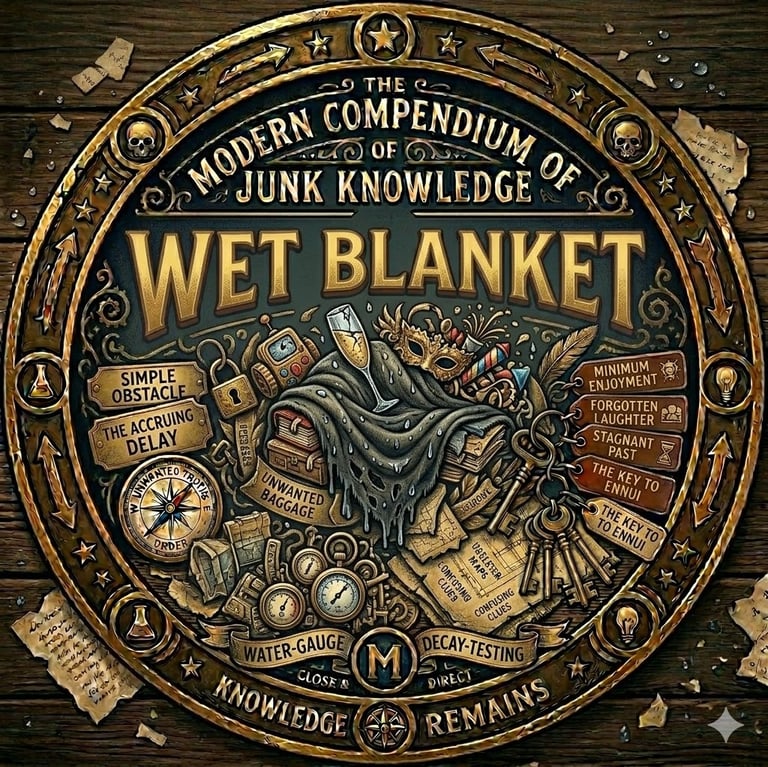
The Definition
A person who discourages enthusiasm or spoils the fun of others; a "killjoy" or "party pooper." Like a heavy, water-logged piece of wool, this person "smothers" the spark of a good time before it can turn into a real fire.
The Deep Dive
This is a "high-saturation" piece of junk knowledge that traces back to the literal, life-saving mechanics of 18th and 19th-century home safety. Before the invention of chemical fire extinguishers, a "wet blanket" was the most important tool in an American kitchen.
The Open Hearth: In the 1700's, cooking was done over open flames. Grease fires, chimney sparks, and stray embers were a constant threat to wooden homes.
The "Quenching" Tool: Every household kept a heavy wool blanket nearby. If a fire broke out—on the stove or on a person's clothing—the quickest way to stop it was to douse the blanket in a bucket of water and throw it over the flames.
The Science of Smothering: Fire requires oxygen to survive. A dry blanket might catch fire itself, but a wet blanket creates a heavy, airtight seal. It instantly robs the fire of its "breath," turning a roaring, energetic flame into a pile of cold, damp ash.
The Metaphorical Shift: By the 1820's, people began to notice that some dinner guests had the same effect on a lively conversation. If the "fire" of a party was a witty debate or a joyful celebration, the "wet blanket" was the person who walked in with a cynical comment or a boring complaint and "quenched" the social energy of the room.
The phrase reached peak popularity in the Victorian Era, when social etiquette was as strictly regulated as a fireplace. It was famously used by writers like Charles Dickens to describe characters who were "habitually damp" in spirit.
Fast Facts
The "Blanket" Evolution: In the early 1900's, "blanket" became a verb meaning "to cover everything," which led to the term "blanket policy" or "blanket statement."
The "Throw a Damper" Link: This is a direct linguistic cousin. A "damper" is the metal plate in a chimney that controls the airflow; "throwing a damper" on a situation is the mechanical equivalent of using a wet blanket.
The First Print: The specific idiom "he is a regular wet blanket" appeared in the New York Mirror in 1830, used to describe a critic who hated a new play.
References
Dickens, C. (1848). Dombey and Son. (On the 'damp' nature of the gentry).
Ammer, C. (2013). The Dictionary of Clichés. Skyhorse Publishing.
Flexner, S. B. (1982). Listening to America. Simon & Schuster.
The Oxford English Dictionary. (2026). Blanket (n.). Oxford University Press.