Whale of a Time
The Definition
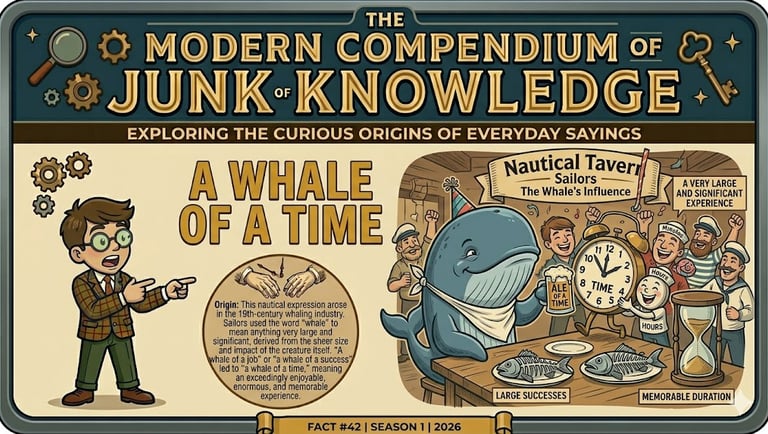
A colloquial idiom meaning to have an exceptionally enjoyable, exciting, or grand experience. It suggests a "load" of fun that is massive in scale, often implying a sense of carefree indulgence or a celebration that feels larger than life.
The Deep Dive
The "junk knowledge" behind "a whale of a time" is that it is a late 19th-century linguistic "growth spurt." In the Victorian era, the word "whale" became a popular slang term for anything that was extraordinarily large, impressive, or "top-shelf."
The Superlative Sea: Before we had "whale of a time," students and sailors used "whale" as a generic intensifier. If you were a great student, you were a "whale at math." If a story was incredibly bold, it was a "whale of a lie." Using the largest animal on Earth as a metaphor for "size" was a bit of 1890's "junk" hyperbole that finally settled into the context of having fun.
The "Junk" of Abundance: The phrase implies a "bigness" that is uncontainable. To have a "whale of a time" isn't just to be happy; it’s to be engulfed in the experience, much like Jonah was engulfed by the great fish. It’s the feeling of being "at sea" in a good way, where the "kith and kin" and the music are all contributing to a massive, singular wave of joy.
The "Americanism" Label: While "whale" slang was used in the UK, "a whale of a time" is widely considered an Americanism that gained global traction in the early 1900's. It reflects the boisterous, "800-pound gorilla" energy of a growing America that wanted everything—including its leisure—to be king-sized.
The phrase reached peak "junk" status in the mid-20th century, becoming the quintessential way to describe a vacation or a successful party. It represents the "junk" of scale: the belief that for a moment to be truly memorable, it needs to be "whale-sized."
Fast Facts
The "Barnum" Effect: Some etymologists suggest the phrase was boosted by the era of P.T. Barnum, where "the biggest" was always the best. If a show was a "whale," it was a hit.
The "Moby Dick" Contrast: Unlike the dark, obsessive "whale" of Herman Melville’s novel, this "whale" is entirely positive. One whale takes your leg; the other gives you a "license to print money" in terms of memories.
The "Gaseous" Evolution: In very old British slang, "to whale" meant to beat someone (as with a whalebone). Thankfully, that "junk" meaning was "given the axe" by the more cheerful "whale of a time" by the turn of the century.
References
Ammer, C. (2013). The Dictionary of Clichés. Skyhorse Publishing.
Lighter, J. E. (1994). Historical Dictionary of American Slang.
Oxford English Dictionary. (2026). The Use of Marine Mammals as Idiomatic Intensifiers.