What’s Done is Done
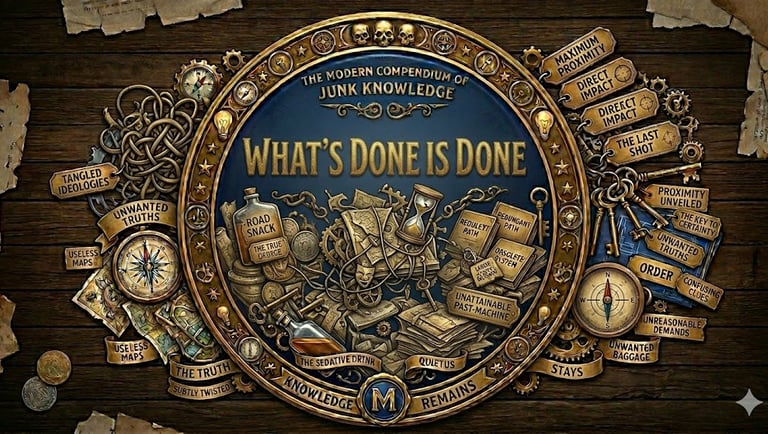
The Definition
A fatalistic idiom used to express that a past event or decision cannot be altered, undone, or retracted. It serves as a linguistic "period" at the end of a sentence, signaling that further regret, debate, or rumination is futile. It is the ultimate verbal shrug in the face of the unchangeable.
The Deep Dive
The "junk knowledge" behind "what's done is done" is that it is one of the many "stolen" phrases from William Shakespeare that has become so common we’ve forgotten its dark, murderous origin. It wasn’t a phrase of comfort; it was a phrase of suppression.
The Macbeth Connection: The line is famously spoken by Lady Macbeth in Act III, Scene 2 of Macbeth (c. 1606). After she and her husband have murdered King Duncan, Macbeth is spiraling into guilt and paranoia. Lady Macbeth snaps at him: "Things without all remedy / Should be without regard: what's done is done." She isn't being "mindful"—she’s telling him to stop acting guilty so they don’t get caught.
The "Un-doing" Paradox: Interestingly, later in the play, as Lady Macbeth herself succumbs to madness and tries to wash imaginary blood from her hands, she reverses the phrase, whispering, "What's done cannot be undone." This reveals the "junk" of human psychology: we tell ourselves the past is settled to stay sane, but our subconscious often knows better.
The Law of Entropy: In a scientific sense, the phrase is a layman’s version of the Second Law of Thermodynamics. Once energy is expended or a physical change occurs (like an egg being broken), the universe's "arrow of time" prevents the system from returning to its original state without a massive injection of new energy. "What's done is done" is simply the emotional acceptance of entropy.
The phrase reached peak "junk" status in the 20th century as the favorite mantra of "no-regrets" philosophers and high-stakes gamblers. It represents the "junk" of closure: the necessary lie we tell ourselves so we can keep moving forward instead of "scattering to the winds" of our own past mistakes.
Fast Facts
The Sophocles Link: While Shakespeare popularized the English wording, the sentiment is ancient. The Greek playwright Sophocles wrote in The Trachiniae (c. 450 BCE): "For what is done, not even a God can make undone."
The "Spilled Milk" Rival: While "what's done is done" is serious and often dark, "don't cry over spilled milk" is its domestic, low-stakes cousin. One is for regicide; the other is for the kitchen.
The Legal "Fait Accompli": In international law and politics, a similar concept is the fait accompli (an accomplished fact). It describes a move made so decisively that it's "too late" for opponents to intervene, forcing them to accept the new reality.
References
Shakespeare, W. (1606). Macbeth.
Sophocles. (c. 450 BCE). The Trachiniae.
Ammer, C. (2013). The Dictionary of Clichés. Skyhorse Publishing.