White Elephant
The Definition
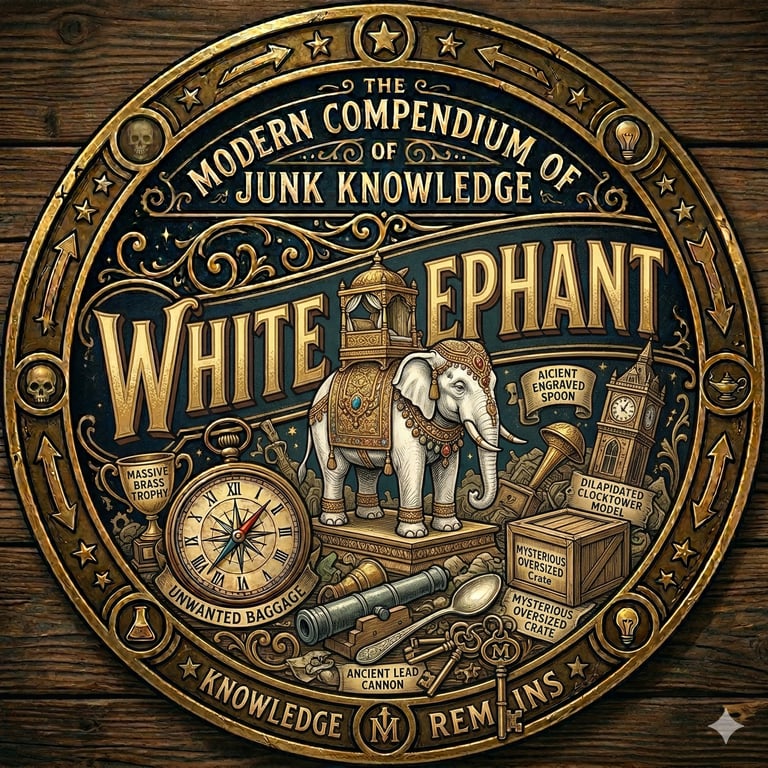
A possession that is useless, troublesome, or extremely expensive to maintain, especially one that is difficult to dispose of. In modern gift exchanges, it refers to a humorous, impractical, or "junk" item that nobody actually wants but everyone is forced to trade.
The Deep Dive
This is a "high-tonnage" piece of junk knowledge that traces back to the literal, biological rarity of albino elephants in the ancient kingdoms of Siam (modern-day Thailand).
The Sacred Status: In Southeast Asian culture, a white elephant was not just a pet; it was a sacred manifestation of royal power and good fortune. Because they were so rare, any white elephant discovered in the wild automatically became the property of the King.
The "Royal" Problem: Because the animal was sacred, it could not be worked. You couldn't use a white elephant to haul logs, carry soldiers into battle, or plow a field. It had to be kept in a palace, fed the finest grains, washed in scented water, and adorned with gold and jewels. It was an enormous, walking "expense account" that produced zero income.
The "Gift" of Ruin: The King of Siam allegedly turned this sacred blessing into a weapon of passive-aggressive warfare. If a courtier or a nobleman displeased the King, the King wouldn't execute him. Instead, he would "honor" the man by giving him a White Elephant.
The Bankruptcy: The recipient could not refuse a royal gift, nor could they sell a sacred animal, nor could they put it to work. They were forced to spend their entire fortune housing and feeding the beast until they were financially ruined. The "gift" was a death sentence for their bank account.
The phrase "migrated" to the West in the mid-19th century. It was famously used by P.T. Barnum, who actually imported a "White Elephant" (which turned out to be a normal grey elephant with some light spots), leading to a public outcry and solidifying the term as a synonym for a "scam" or a "useless burden."
Fast Facts
The "Pink" Elephant Link: While a "white elephant" is a financial burden, a "pink elephant" (popularized in the early 1900's) refers to a hallucination caused by severe alcohol withdrawal.
The "Jumbo" Connection: P.T. Barnum’s most famous elephant, Jumbo, was the opposite of a white elephant—he was a massive "grey" success that actually made money.
The First Print: The term "white elephant" was used in English as early as the 1600's by travelers, but it wasn't used as a general idiom for a "useless possession" until the 1850's.
References
Barnum, P. T. (1889). The King of the Animal Kingdom. (On the white elephant hype).
Bowring, J. (1857). The Kingdom and People of Siam.
Ammer, C. (2013). The Dictionary of Clichés. Skyhorse Publishing.
The Oxford English Dictionary. (2026). Elephant (n.). Oxford University Press.