Who Cut the Cheese
The Definition
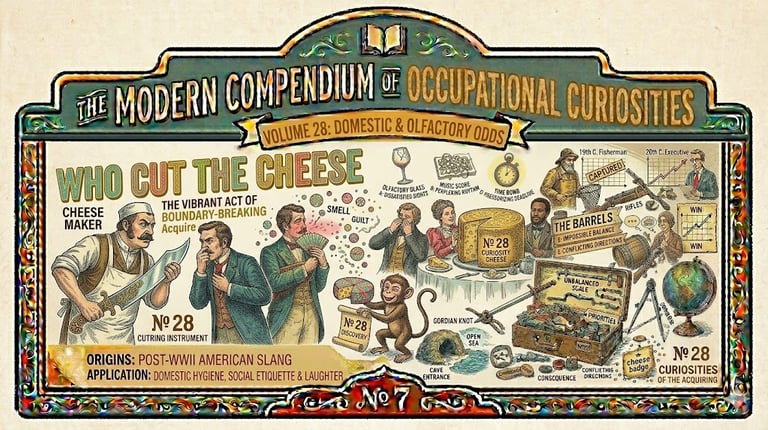
"Who cut the cheese?" is a common, slightly crude American slang euphemism used to ask who has just flatulated. It represents a humorous, playground-level linguistic deflection, using a distinct culinary aroma to call out an invisible olfactory offense without using clinical or overly vulgar terms.
The Deep Dive
While the phrase feels like a permanent fixture of 20th-century schoolyard humor, its roots are deep-set in the centuries-old physics of traditional dairy preservation and the unvarnished biochemistry of fermentation.
The Chemistry of the Wheel: Long before modern refrigeration or vacuum-sealed plastics were engineered, cheese was preserved by aging it in large, dense wheels or blocks. To protect the interior dairy fat from spoiling or drying out, cheesemakers allowed a thick, hard, organic rind to develop around the outside of the wheel. This rind acted as a natural hermetic seal.
The Trapped Gas: During the long aging process, active bacterial cultures inside the cheese continue to consume lactose, breaking down proteins and fats. As a byproduct of this fermentation, the bacteria release various gases—most notably hydrogen sulfide and methyl mercaptan. Because the outer rind is incredibly dense and unyielding, these sulfurous, sharp gases cannot escape. Instead, they become highly pressurized and trapped within the cellular structure of the dairy wheel.
The Knife Inversion: The moment a grocer, a chef, or a line cook takes a large knife and pierces that hard outer rind to slice off a wedge, the physical seal is shattered. The sudden drop in pressure causes the trapped, hyper-concentrated sulfurous gases to instantly burst outward into the room.
The Visual Metaphor: Because the specific chemical compounds released by a freshly punctured wheel of aged dairy (like Limburger, Roquefort, or sharp cheddar) are molecularly identical to the compounds produced by human digestion, a crowded kitchen would instantly fill with a sharp, unmistakable odor. By the mid-20th century, American youth had hijacked this literal kitchen phenomenon, turning it into a premier piece of domestic slang. When an anonymous odor suddenly contaminated a room, shouting "Who cut the cheese?" blamed the occurrence on a metaphorical kitchen knife, transforming a moment of social awkwardness into a fast, defensive joke.
Fast Facts
The "Cutting" Connection: The use of the verb "cut" to describe flatulence is incredibly old. It dates back to at least the 16th century in English slang, where phrases like "cutting a wind" or "cutting a fart" were used to describe a sudden, sharp release of pressure.
The "He Who Smelt It" Rule: In folklore and childhood sociology, the phrase is bound to a rigid set of unwritten, conversational counter-laws designed to assign blame, such as "He who smelt it, dealt it" or the defensive legal pivot, "He who denied it, supplied it."
References
Mencken, H. L. (1948). The American Language: Supplement II. Alfred A. Knopf. (Documenting the rise of Gilded Age and mid-century culinary slang variations).
Green, J. (2010). Green's Dictionary of Slang. Chambers Harrap.
Oxford English Dictionary. (2026). The Lexical Integration of Fermentation Byproducts and Domestic Schoolyard Euphemisms.