Whoopee Cushion
The Definition
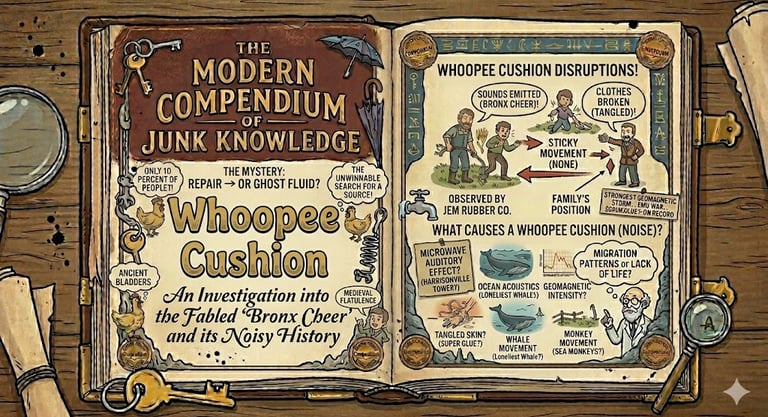
A practical joke device consisting of a rubber bladder that, when sat upon, forces air through a narrow opening to create a sound mimicking flatulence. It is the ultimate icon of "bathroom humor," designed to cause maximum social embarrassment for the victim and juvenile delight for the prankster.
The Deep Dive
The "junk knowledge" behind the Whoopee Cushion is that it is a modern, industrial version of an ancient Roman insult. While we associate it with 20th-century novelty shops, the concept of the "noise-making cushion" dates back nearly two thousand years.
The Roman Emperor’s Prank: The teenage Emperor Heliogabalus (218–222 AD) was notorious for his eccentric and often cruel sense of humor. Historical accounts suggest he frequently used air-filled bladders at dinner parties, hidden under the cushions of his most pompous guests, to deflate their dignity along with the air.
The Rubber Revolution: The modern Whoopee Cushion was "re-invented" in the late 1920's by the JEM Rubber Co. in Toronto, Canada. Employees there were experimenting with scrap rubber and created a prototype that was far more effective (and louder) than a pig's bladder.
The J.S. Adams Pivot: The company offered the invention to Samuel Adams, the "King of Pranks" and founder of S.S. Adams Co. Surprisingly, Adams initially rejected it, calling it "too vulgar" for the American public. However, after a smaller competitor began selling them successfully, Adams relented, and the "Whoopee Cushion" (named after the popular 1928 song "Makin' Whoopee") became a worldwide bestseller.
The Whoopee Cushion reached peak "junk" status in the mid-20th century, becoming a mandatory prop in cartoons and sitcoms. It represents the "junk" of human maturity: the fact that no matter how sophisticated our civilization becomes, a well-timed, artificial "raspberry" sound remains one of the most reliable ways to get a laugh.
Fast Facts
The Self-Inflating Upgrade: The original Whoopee Cushions had to be manually blown up after every use. In the 1990's, the "self-inflating" version was introduced, featuring a piece of open-cell foam inside that draws air back in automatically, allowing for "rapid-fire" pranking.
The Science of the Squeal: The sound is produced by two rubber flaps at the neck of the cushion. As the air is forced out, the flaps vibrate against each other at high speed—a process known in linguistics and acoustics as a "labial-lingual bilitteration."
The "Windy City" Connection: During the Great Depression, the Whoopee Cushion was one of the few luxury items people continued to buy, as it provided a cheap way to lighten the mood during dark financial times.
References
Adams, S. S. (1930). The S.S. Adams Catalog of Novelties.
Lamothe, R. (2013). The Book of Jokes: A History of Practical Pranks.
The Canadian Museum of History. (2026). The JEM Rubber Co. Archives.