Wild Goose Chase
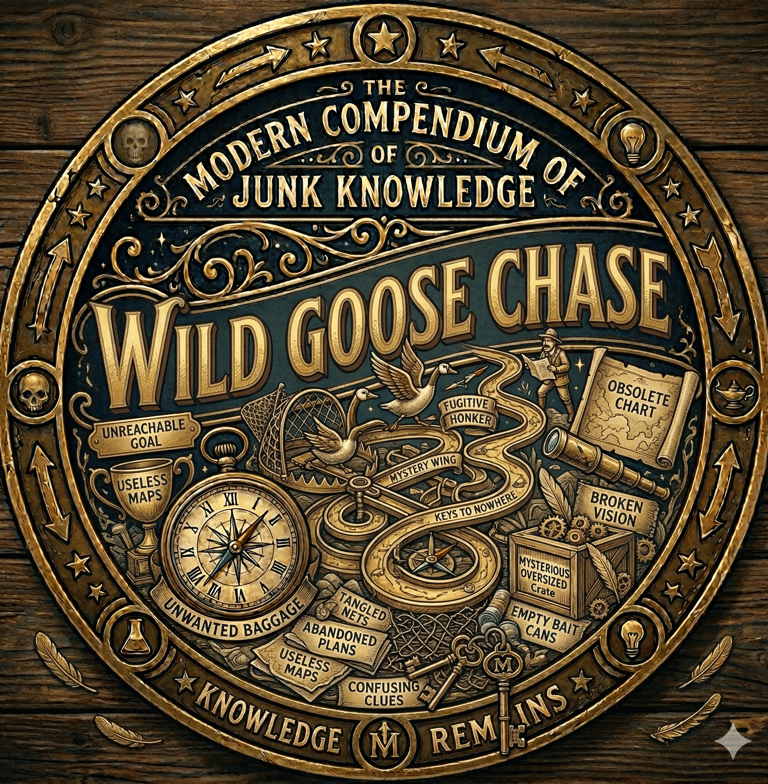
The Definition
A frustrating, hopeless, or lengthy search for something that is unattainable or doesn't exist. It describes a pursuit that is poorly planned and ultimately a complete waste of time and energy.
The Deep Dive
While modern users might imagine a literal person running through a park trying to catch a disgruntled Canada goose, the origin is much more structured and comes from the world of 16th-century horse racing.
A "Wild Goose Chase" was a specific type of race where the lead rider would set a frantic, unpredictable course across open country. The other riders were required to follow at set intervals, mimicking the V-formation of wild geese in flight.
The Lead Goose: The lead horse acted as the "leader." They could turn sharply, jump fences, or head into difficult terrain at will.
The Followers: The following riders had to mimic every move of the leader exactly. If the leader veered left, the second rider had to veer left at the same spot, followed by the third, and so on.
The Futility: Because the leader had all the control and the followers were always reacting, it was incredibly difficult to overtake the front-runner. The race often ended in total exhaustion for the horses with no clear "winner" other than the person who didn't collapse first.
The phrase was immortalized in literature by William Shakespeare in Romeo and Juliet (1595). Mercutio tells Romeo: "Nay, if thy wits run the wild-goose chase, I have done; for thou hast more of the wild-goose in one of thy wits than, I am sure, I have in my whole five." By the 19th century, the literal horse race was forgotten, and the phrase became a general term for any "goosey" or foolish pursuit.
Fast Facts
The Formation: The V-formation of real geese is an aerodynamic strategy to save energy; the "Wild Goose Chase" horse race was the opposite—a high-energy waste of effort.
The "Goose" Connection: Geese were chosen as the namesake because of their reputation for being flighty, unpredictable, and difficult to herd or lead in a straight line.
The "Snipe Hunt" Sibling: A related American "junk knowledge" prank is the "Snipe Hunt," where a newcomer is sent into the woods at night with a bag to catch a non-existent bird, representing the ultimate "Wild Goose Chase."
References
Shakespeare, W. (1595). Romeo and Juliet. (Act II, Scene 4).
Markham, G. (1599). How to Chuse, Ride, Traine, and Diet, Both Hunting-horses and Running-horses.
Ammer, C. (2013). The Dictionary of Clichés. Skyhorse Publishing.
The Oxford English Dictionary. (2026). Goose (n.). Oxford University Press..