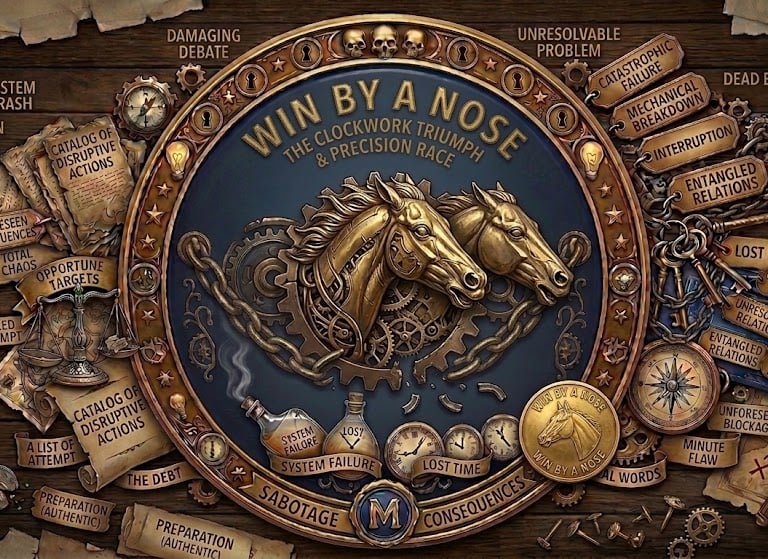
Win by a Nose
The Definition
This idiom describes a victory achieved by the narrowest possible margin. It signifies a situation where the difference between success and failure is infinitesimal, representing a "close shave" in a competitive environment.
The Deep Dive
The phrase is a literal reference to horse racing, where the physical anatomy of the animal determines the official outcome of a contest.
The Finish Line Metric: In Thoroughbred racing, the winner is determined by which horse’s nose crosses the finish line first. Unlike human track events, where the torso is often the deciding factor, horse racing officials focus strictly on the snout. Because a horse's head is long, a "nose" is the smallest measurable unit of victory—shorter than a "head," a "neck," or a "length."
The Introduction of the Photo Finish: Before the advent of high-speed cameras, judges had to "face the music" of angry crowds if they made a mistake in a close call. The "photo finish" was developed in the late 19th century specifically to capture the moment a horse would "win by a nose," providing objective proof in a sport where betting stakes were a tall order for the average spectator.
Linguistic Expansion: By the early 20th century, the phrase migrated from the racetrack to politics and business. It began to describe any narrow win, such as a candidate winning an election by a handful of votes or a company securing a contract by a fraction of a percent in a bidding war.
Fast Facts
The "By a Whisker" Rival: While "win by a nose" is specific to racing, "by a whisker" is a feline-based alternative that implies an even smaller, almost microscopic margin of success.
The Official "Nose" Length: In the official charts of the Daily Racing Form, a "nose" is the smallest margin recorded, followed by a "head" (approx. 0.2 lengths) and a "neck" (approx. 0.3 lengths).
References
Ammer, C. (2013). The Dictionary of Clichés. Skyhorse Publishing.
Daily Racing Form. (2026). Glossary of Racing Terms and Margins.
Oxford English Dictionary. (2026). The Impact of Sporting Jargon on 19th-Century Vernacular.