Working for Peanuts
The Definition
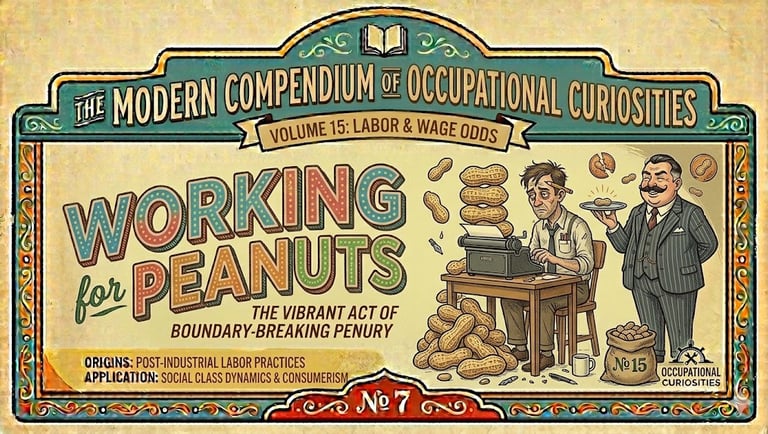
This idiom refers to working for very little pay or a salary that is barely enough to cover basic necessities. It describes a situation where the compensation is so meager that it feels almost insulting, as if the employer is offering a snack rather than a living wage.
The Deep Dive
The phrase is an Americanism that grew out of the entertainment and agricultural worlds of the 19th century, where peanuts were the ultimate symbol of cheap, bulk goods.
The "Cheap" Nut: In the 1800's, peanuts were not the popular snack they are today. They were often viewed as "junk" food—inexpensive, messy to eat, and primarily associated with the lower classes or used as animal feed. Because a large bag of peanuts cost almost nothing, they became a linguistic shorthand for any trivial or insignificant amount of money.
The Circus Connection: One of the most persistent theories links the phrase to the traveling circus. Elephants, the stars of the show, were famously "paid" in peanuts by the audience. By extension, human performers or laborers who were poorly compensated were said to be working for the same "pay" as the animals. If a job offered no "meat" (real wages), it was dismissed as a peanut-only endeavor.
Political Slang: By the 1940's, the phrase had moved into the professional and political sphere. It was used to criticize low minimum wages or unfair labor practices. It suggested that an employer was "coloring outside the lines" of fair play by taking advantage of workers who had no other options, leaving them in a perpetual state of being in the hole.
Fast Facts
The "Peanut Gallery" Link: This related term referred to the cheapest, highest seats in a theater, where the "flock" would sit and often throw peanuts at performers they didn't like. Both idioms reinforce the idea of peanuts as the currency of the poor.
The "Chump Change" Rival: A more modern equivalent that implies the money is so small it is only fit for a "chump" (a fool).
References
Ammer, C. (2013). The Dictionary of Clichés. Skyhorse Publishing.
Lighter, J. E. (1994). Historical Dictionary of American Slang.
Oxford English Dictionary. (2026). The Economic Symbolism of Legumes in American English.