Worth Your Salt
The Definition
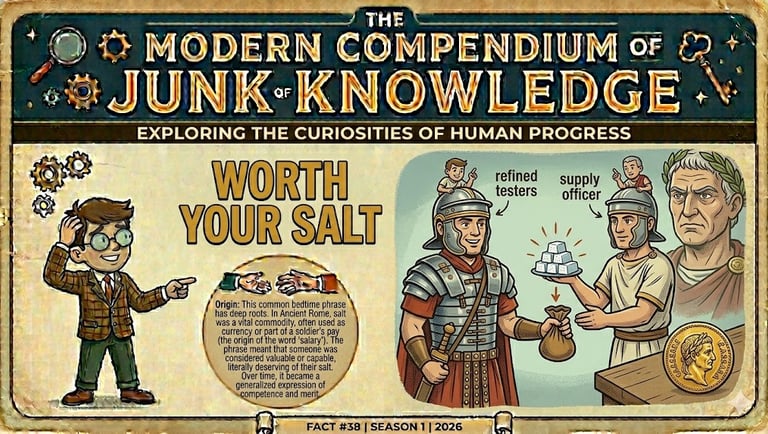
Deserving of one’s pay; competent, efficient, or valuable in a professional capacity. To be "worth your salt" is to provide a level of service or skill that justifies the investment made in you.
The Deep Dive
This is a "high-sodium" piece of junk knowledge that traces back to the literal, mineral economy of the Roman Empire (c. 27 BC – 476 AD). Before the invention of fiat currency or digital banking, salt was one of the most stable and essential commodities on Earth.
The Preservative Power: In the ancient world, salt was not just a seasoning; it was a survival tool. Without refrigeration, salt was the only way to preserve meat for long military campaigns or winter storage. It was literally "white gold."
The "Salarium": Roman soldiers were sometimes paid in salt, or more commonly, given a specific allowance to purchase it. This allowance was called a salarium.
The Linguistic Root: The Latin word salarium is the direct ancestor of our modern English word "salary." * The "Efficiency" Test: A soldier who was lazy, cowardly, or incompetent was seen as a waste of resources. If his performance didn't contribute to the success of the legion, he was literally not "worth his salt"—the cost of keeping him fed and preserved exceeded his value to the Empire.
The phrase moved from the Roman barracks to the general English lexicon in the early 19th century. It was popularized by maritime writers and novelists who used it to describe sailors who "earned their keep" during treacherous voyages. By the 1830's, it had become a standard way to measure a person's professional worth in any field, from blacksmithing to bookkeeping.
Fast Facts
The "Salt of the Earth" Cousin: This is a direct linguistic sibling. While being "worth your salt" refers to your work ethic, being the "salt of the earth" refers to your moral character.
The "Below the Salt" Link: In medieval dining, salt was a status symbol. The large salt cellar sat in the middle of the table; high-ranking guests sat "above the salt" (near the host), while commoners and servants sat "below" it.
The First Print: The specific idiom "worth his salt" began appearing in British literature and newspapers, such as The London Magazine, in the 1820's to describe reliable laborers.
References
Pliny the Elder. (c. 77 AD). Natural History. (On the importance of salt in the Roman economy).
Ammer, C. (2013). The Dictionary of Clichés. Skyhorse Publishing.
Ayto, J. (2011). Oxford Dictionary of English Idioms. Oxford University Press.
The Oxford English Dictionary. (2026). Salary (n.). Oxford University Press.