Wrench in the Works
The Definition
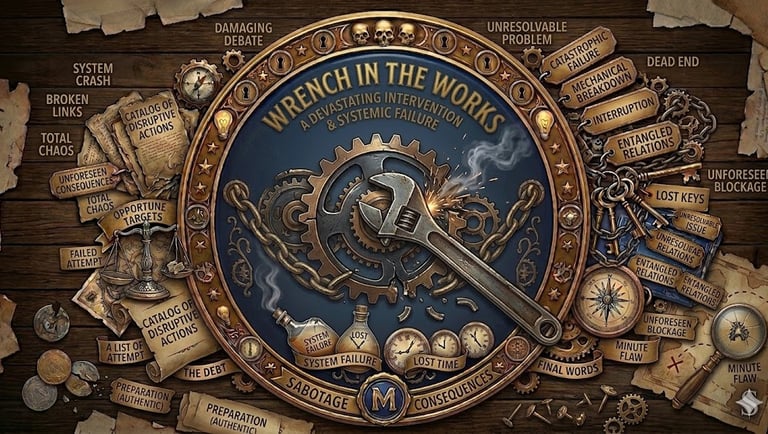
This idiom refers to a sudden or unexpected event that disrupts a plan, process, or smooth operation. It describes an interference that causes a system to stall or fail, much like a physical object jamming a series of moving gears.
The Deep Dive
The phrase is a mechanical metaphor born from the Industrial Revolution, reflecting the transition from hand-powered tools to complex, interconnected machinery.
Industrial Sabotage: During the rise of factory automation, machines were composed of large, exposed gears and belts. A literal wrench dropped into these moving parts would cause immediate, catastrophic failure. In some historical accounts, disgruntled workers would intentionally "throw a wrench in the works" to halt production and protest labor conditions or the threat of automation to their livelihoods.
The "Spanner" Variation: In British English, the idiom is "a spanner in the works." This reflects the regional terminology for the same tool. Both versions gained significant popularity in the late 19th and early 20th centuries as the "brass tacks" of everyday life became increasingly dependent on mechanical reliability.
Modern Interpretation: Today, the phrase is rarely used in a literal mechanical sense. Instead, it describes a tall order of logistical or bureaucratic interference. It signifies the moment an external variable—such as a sudden policy change or a budget cut—intervenes and halts the progress of a project that was previously running smoothly.
Fast Facts
The "Sabotage" Connection: While the word "sabotage" comes from the French sabot (a wooden shoe allegedly thrown into looms), "wrench in the works" is its English industrial counterpart, focusing on the tools of the mechanic rather than the footwear of the peasant.
Mechanical Resilience: Engineers in the early 20th century began designing "guards" and enclosures for machinery specifically to prevent debris or tools from becoming a wrench in the works, leading to the sleek, enclosed designs of modern appliances.
References
Ammer, C. (2013). The Dictionary of Clichés. Skyhorse Publishing.
Ayto, J. (1990). Dictionary of Word Origins. Arcade Publishing.
Oxford English Dictionary. (2026). Industrial Metaphors and the Evolution of Labor Slang.