Writing is on the Wall
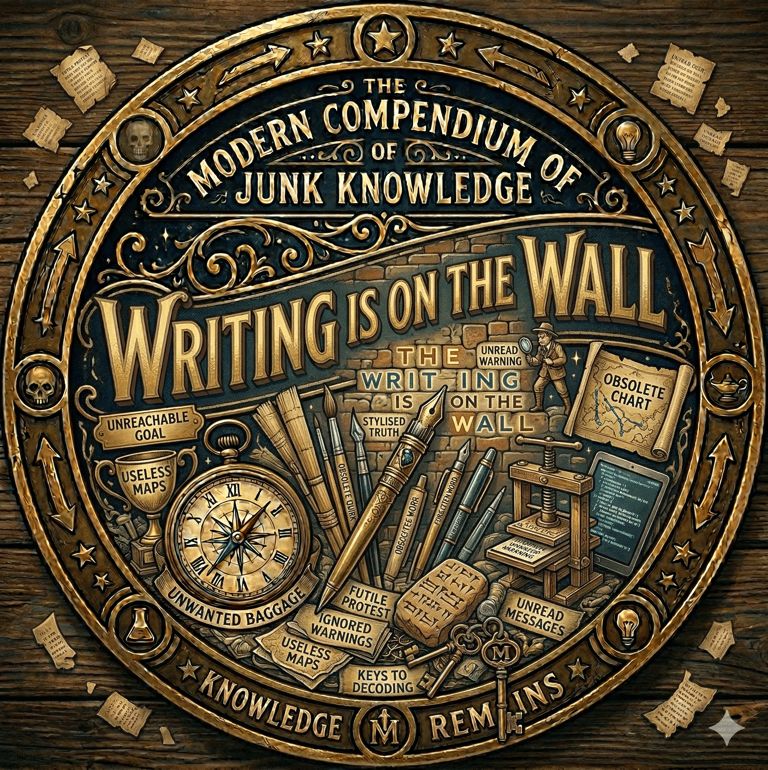
The Definition
A clear and unmistakable sign that doom, failure, or a major misfortune is imminent. It suggests that the end is near and that the outcome is already "written" and unchangeable, even if some people are still trying to ignore it.
The Deep Dive
This is a "high-judgment" piece of junk knowledge that traces back to one of the most terrifying dinner parties in recorded history. While we now use it to describe a failing tech startup or a collapsing political campaign, the origin is a literal, supernatural event from the Book of Daniel (c. 6th century BC).
Belshazzar’s Feast: King Belshazzar of Babylon was throwing a massive, decadent banquet. To show off his power, he drank wine from sacred gold and silver vessels looted from the Temple in Jerusalem.
The Ghostly Hand: In the middle of the revelry, a disembodied human hand suddenly appeared and began writing a cryptic message in the plaster of the palace wall, directly across from the King’s lampstand.
The "Junk" Code: The King was terrified (his knees literally "smote one against another"). None of his wise men could read the words. Finally, the prophet Daniel was brought in to translate the Aramaic script: MENE, MENE, TEKEL, UPHARSIN.
The Translation: Daniel explained the "writing on the wall" was a divine audit:
Mene: God has numbered your kingdom and finished it.
Tekel: You have been weighed in the balances and found wanting.
Peres (Upharsin): Your kingdom is divided and given to the Medes and Persians.
The Immediate Result: According to the text, Belshazzar was killed that very night, and his empire fell exactly as the wall had predicted.
The phrase "the writing on the wall" became a secular English idiom in the mid-18th century. It moved from the pulpit to the counting-house, used by economists and social critics to describe "obvious" signs of an approaching crisis that the "King" (the establishment) was too arrogant to see.
Fast Facts
The "Weighed and Wanting" Link: This is a direct linguistic sibling. To be "found wanting" comes from the same "Tekel" portion of the wall's message, referring to a coin that is underweight and therefore counterfeit.
The "Mene" Repetition: In the original text, Mene is written twice, likely to emphasize that the decision was final and the "deadline" had already passed.
The First Secular Print: While the Bible story was universal, the phrase appeared as a common political metaphor in British journals like The Spectator by the 1710's.
References
The Holy Bible. (King James Version). Daniel 5:1–31.
Rembrandt. (1635). Belshazzar's Feast. (The definitive oil painting of the 'writing' moment).
Ammer, C. (2013). The Dictionary of Clichés. Skyhorse Publishing.
The Oxford English Dictionary. (2026). Wall (n.1). Oxford University Press.