Yes Man
The Definition
A "yes man" is a derogatory term for a person—typically an assistant, subordinate, or corporate courtier—who consistently agrees with every opinion, proposal, or decision put forth by their superior, regardless of its actual merit, logic, or ethics. Operating without an unvarnished personal filter, a yes man sacrifices their critical thinking and professional autonomy to maintain their proximity to power and avoid the career risks of dissent.
The Deep Dive
The phrase is a direct product of the rapid corporate and political industrialization of early 20th-century America, capturing the collective public anxiety about the loss of individual grit within massive bureaucratic machines.
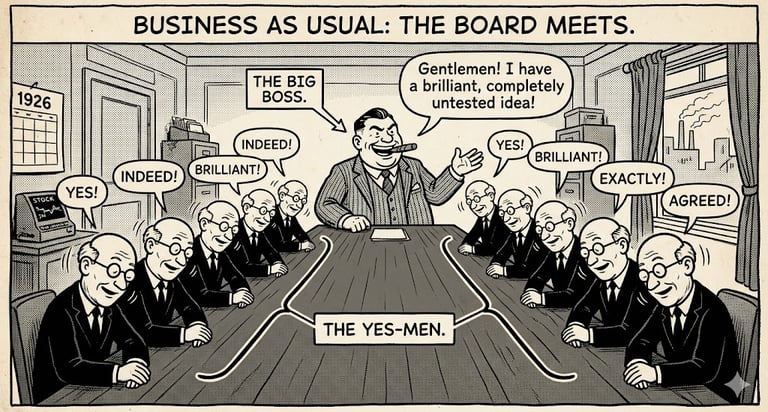
The Cartoonist’s Invention: While the human instinct to fawn over a ruler is as old as ancient empires, the specific phrase "yes man" was coined and popularized in the 1910's by American newspaper cartoonists and sports journalists, most notably T.A. Dorgan (who wrote under the pen name "Tad"). Dorgan drew satirical comic strips mocking corporate boardrooms, political conventions, and boxing managers. He noticed a highly specific character archetype always lingering in the background: a flock of nervous, identical-looking assistants who would nod in unison and chime in with a loud "Yes!" the absolute millisecond the boss spoke a line. Dorgan began labeling these background figures as "The Yes-Men" in his speech bubbles.
[Image diagram of a 1920’s satirical comic strip detailing a booming corporate executive at a long table surrounded by identical, nodding assistants labeled "The Yes-Men"]
The Hollywood Factory: The phrase transitioned from newspaper print to universal cultural currency with the rise of the early Hollywood studio system in the 1920's and 30's. Studio moguls like Louis B. Mayer and Samuel Goldwyn wielded absolute, dictatorial power over writers, directors, and actors. To protect their fragile egos and massive financial investments, these moguls surrounded themselves with entourage members whose sole professional function was to validate the executive's creative whims. Writers quickly began using "yes man" as a sharp, bitter piece of industry slang to describe these highly paid yes-singing sycophants.
The Psychology of Compliance: In modern organizational psychology, the proliferation of yes men within an enterprise is studied under the framework of Groupthink and Obedience to Authority. When a leadership style values absolute loyalty over intellectual honesty, a defensive survival mechanism is triggered within the ranks. Subordinates realize that offering constructive friction or pointing out a structural flaw in a project will get them marginalized or benched, while automatic agreement preserves their status. Over time, this filters out independent talent, leaving behind a sterile echo chamber that leaves the organization completely vulnerable to catastrophic blind spots.
Fast Facts
The Goldwynism Mirror: The famous Hollywood producer Samuel Goldwyn perfectly unmasked the inherent paradox of the yes man when he delivered a legendary, ironic piece of executive wisdom: "I don't want any yes-men around me. I want everyone to tell me the truth, even if it costs them their jobs."
The "Devil's Advocate" Antonym: In modern institutional design, the structural antidote to a yes man is the formal designation of a "Devil's Advocate"—an individual or committee explicitly tasked with finding the flaws, projecting the failures, and thoroughly stress-testing a proposal before it is executed, ensuring that consensus is earned rather than merely performed.
References
Dorgan, T. A. (1913). The National Proliferation of Tad's Lexical Innovations. New York Journal.
Janis, I. L. (1972). Victims of Groupthink: A Psychological Study of Foreign-Policy Decisions and Fiascoes. Houghton Mifflin. (Detailing the organizational hazards of institutional echo chambers).
Oxford English Dictionary. (2026). The Etymological Transmutation of Comic Strip Satire into Mid-Century Corporate Vernacular.