The Definition
A substantial, satisfying, and balanced meal. It implies a serving that is nutritionally complete and large enough to leave the eater fully sated.
The Deep Dive
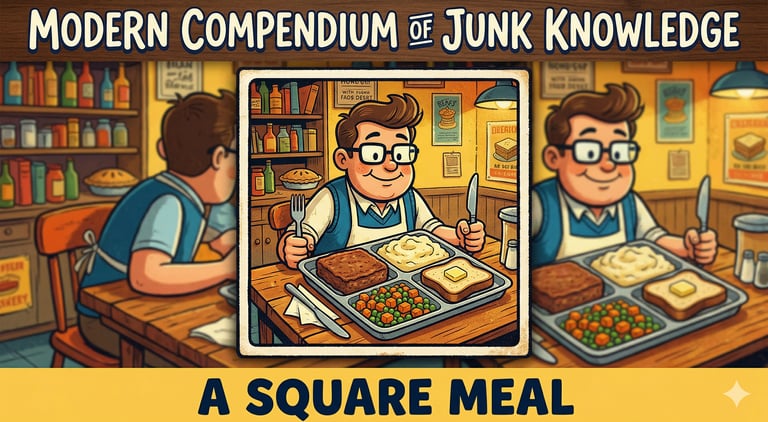
The "junk knowledge" surrounding this phrase is perhaps the most persistent myth in the English language. If you ask a tour guide on a historic ship, they will almost certainly tell you that sailors in the Royal Navy ate off square wooden plates. Because the plates were square, the meal was "square."
While it is true that many 18th-century "trenchers" (plates) were square—to save space and make them easier to stow in a ship's tight quarters—there is zero linguistic evidence linking the shape of the plate to the idiom. In fact, the phrase "square meal" didn't even appear in print until the mid-19th century, long after round plates had become the standard at sea.
The "Square" of Honesty: The true origin lies in the older, metaphorical use of the word "square" to mean honest, fair, or proper. Think of "a square deal" or "fair and square."
The American Frontier: The phrase actually rose to prominence in the United States during the California Gold Rush (c. 1850s). For miners who spent weeks eating meager rations of "hard tack" and salt pork, a "square meal" was a "proper" meal—one with fresh meat, vegetables, and bread served at a table.
The term was popularized by advertisements for restaurants in gold-rush towns like San Francisco, which promised "A Square Meal for 75 Cents." It was an assurance to the customer that they wouldn't be cheated on the portion size or the quality of the ingredients.
Fast Facts
The First Print: One of the earliest recorded uses is from the Mountain Democrat in Placerville, California, in 1856: "We hope... to be able to give our readers a square meal."
The Trencher: The square wooden plates used on ships were called "trenchers" (from the Old French tranchier, to cut). While they were square, sailors referred to their food as "mess" or "provisions," never as a "square meal."
The "Square" Symbolism: In Masonry and other traditional guilds, the "square" (the tool) represented morality and truth, further reinforcing the idea of a "square" meal being one that is "true" and "just."
References
Ammer, C. (2013). The Dictionary of Clichés. Skyhorse Publishing.
Quinion, M. (2004). Port Out, Starboard Home: The Rise and Fall of the Nautical Metaphor. Penguin.
The Mountain Democrat. (1856, November). Local Advertisements and Editorials.
Oxford English Dictionary. (2026). Square (adj. and n.). Oxford University Press.ity Press.
© 2025. All rights reserved.