Junk Knowledge Idioms
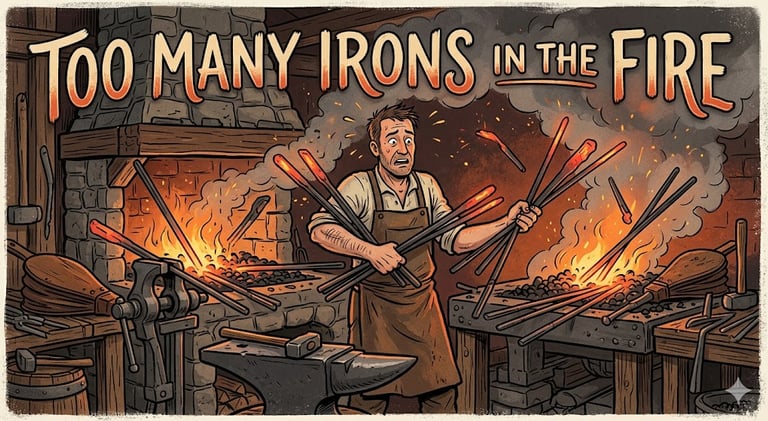
In the modern world, we wear our over-commitment like a badge of honor. We "hustle," we "multitask," and we "pivot." When we feel the walls closing in, we often reach for a piece of linguistic comfort food to explain our stress: “I’ve just got too many irons in the fire.”
It is a phrase that perfectly captures the anxiety of the 21st-century calendar, but its origins are significantly more dangerous—and more physical—than a crowded inbox. To understand this "junk" bit of knowledge, we have to travel back to a time when "work" was defined by the smell of coal smoke and the ringing of an anvil.
The Blacksmith’s Burden
The phrase is a literal description of the limitations of the blacksmith’s forge. In the pre-industrial era, a smith’s efficiency was dictated by the "heat." Iron is only malleable when it reaches a specific temperature—roughly 2,000 to 2,500 degrees Fahrenheit—indicated by a glowing yellowish-white color.
A productive smith would keep several different projects—several different "irons"—buried in the glowing coals at once. While he hammered out a horseshoe on the anvil, a set of gate hinges would be heating up in the forge. The goal was a seamless transition from one task to the next.
However, the "fire" is an unforgiving master. If a smith had too many irons in the fire, he reached a tipping point of diminishing returns. Iron left too long in high heat begins to "scale"—the carbon in the metal reacts with the oxygen, causing the surface to flake off and the metal to become brittle. If the smith couldn't get an iron to the anvil in time, the project was literally destroyed by the very heat intended to shape it.
The Moral of the Metal
When the phrase began to migrate into our daily vocabulary in the mid-1500s, it wasn't just a comment on being busy; it was a warning against greed and the loss of quality. To have too many irons in the fire was to admit that you were about to ruin your work through neglect.
Today, we use the phrase to excuse our busyness. But the blacksmith used it to describe his failure. It serves as a reminder that focus is a finite resource, and even the strongest iron will eventually burn if you leave it in the heat too long
The Oxford English Dictionary (OED): Records the first figurative use in 1549: "A man that hath many yrons in the fyre." This confirms the phrase was already being used as a metaphor for over-extending one's interests nearly 500 years ago.
Francis Grose, A Classical Dictionary of the Vulgar Tongue (1785): Grose lists the phrase as common parlance for "one who has many projects or businesses in hand at the same time," often with the implication that some will be neglected.
Moxon, Joseph. Mechanick Exercises: Or the Doctrine of Handy-Works (1677): One of the first English-language manuals on smithing. Moxon details the specific dangers of "over-heating" iron and the necessity of managing the "heats" of various tools simultaneously.
Sallows, J.F. The Blacksmith's Guide (1907): Provides a technical breakdown of "scaling" and the physical degradation of iron when left unattended in a high-heat forge environment.
© 2025. All rights reserved.