Bee-Line
The Definition
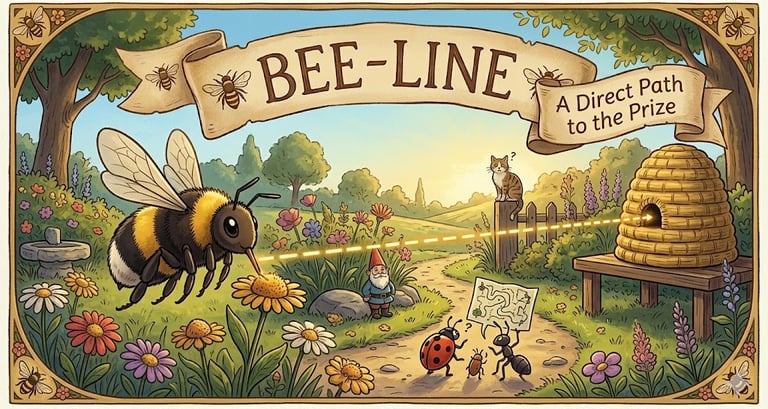
To make a "bee-line" for something means to take the straightest, most direct route possible between two points, completely bypassing any distractions, obstacles, or winding paths. It is an idiom that praises absolute spatial efficiency, typically used when someone is moving with intense focus toward a specific destination.
The Deep Dive
While the phrase is used today to describe a mathematically perfect straight line, its origins are rooted in early American wilderness observation and a slightly flawed understanding of insect behavior.
The Beelining Hunters: In the 18th and 19th centuries, before the widespread commercialization of honeybees, finding a wild hive in the woods was a lucrative skill. Frontiersmen practiced a craft known as "bee-hunting" or "beelining." A hunter would capture a few foraging bees, feed them sugar water, and release them.
The Satiated Return: Foraging bees fly in erratic, looping paths while searching for pollen. However, once a worker bee has loaded up on nectar or water, it aims to return to the hive as quickly and efficiently as possible to share the prize. The bee-hunter would carefully watch the direction the loaded bee took when it flew away—knowing that this direction pointed in an unswerving path straight to the colony. By repeating this process from a second location, the hunter could cross-reference the two lines (triangulation) to pinpoint the exact location of the hive.
The Aviation Clarification: Modern high-speed photography and entomology have revealed that bees don't actually fly in a mathematically perfect geometric line. Wind currents, predators, and landscape markers cause them to make minor adjustments. However, compared to their chaotic, looping search patterns, their return journey appears remarkably direct to the naked human eye.
Linguistic Saturation: The phrase "bee-line" first appeared in American print around the 1830’s. It quickly replaced older English expressions like "as the crow flies," largely because the American frontier was heavily populated by wild honeybee tracking. It captured the spirit of a nation obsessed with finding the quickest, most efficient path through untamed territory.
Fast Facts
The Crow vs. The Bee: While a "bee-line" implies a ground-level or immediate direct path taken by a person, "as the crow flies" typically refers to the absolute distance over a landscape, ignoring mountains, rivers, or roads. (Check out “Great Circle Route”)
The "Bee-Line" Railroads: During the American railroad boom of the mid-19th century, several lines that bypassed small towns to connect major cities via the shortest possible track were officially named or nicknamed "The Bee Line."
References
Seeley, T. D. (2016). Following the Wild Bees: The Craft and Science of Bee Hunting. Princeton University Press.
Ammer, C. (2013). The Dictionary of Clichés. Skyhorse Publishing.
Oxford English Dictionary. (2026). The Frontier Origins of American Spatial Idioms.