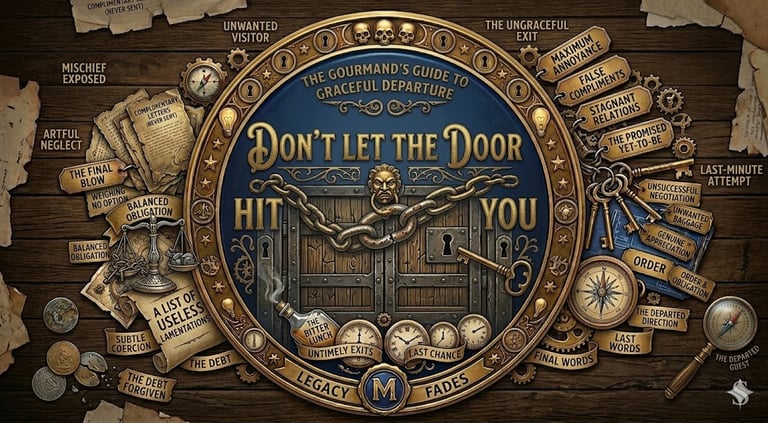
Don't Let the Door Hit You
The Definition
A dismissive and often hostile idiom used to tell someone to leave immediately, with the strong implication that their departure is not only welcome but long overdue. It is the verbal equivalent of "giving the axe" to a guest or an employee, delivered with a "junk" twist of sarcastic concern for their safety on the way out.
The Deep Dive
The "junk knowledge" behind "don't let the door hit you" is that the full phrase—"Don't let the door hit you where the good Lord split you"—is a masterpiece of American "porch wit." It transforms a standard exit into a "low blow" aimed at the person's backside.
The Spring-Loaded Reality: The phrase gained traction in the late 19th and early 20th centuries with the invention of the automatic door closer. Before pneumatic or spring-loaded hinges, doors had to be shut manually. With the new "junk" tech, a door would swing shut automatically behind a person. If you were leaving in a hurry—or being pushed out—the door would literally "hit you" in the rear if you didn't move fast enough.
The "Six Feet Under" Hospitality: In the world of hospitality this is the "anti-welcome." It’s what you say when a guest has "rubbed you the wrong way" so thoroughly that you want them gone before they can even say "what’s done is done."
The "Junk" of Finality: It is a "one-hit wonder" of social rejection. It leaves no room for "water under the bridge" or a "close shave" reconciliation. When someone says this, the "flock" has officially rejected the "bird."
The phrase reached peak "junk" status in mid-century film noir and sitcoms, usually delivered by a tough-talking landlord or a fed-up spouse. It represents the "junk" of impatience: the moment when you are so finished with someone that even the sight of their back is a tough to endure.
Fast Facts
The "Good Riddance" Connection: The phrase is the aggressive cousin of "Good riddance to bad rubbish." While "riddance" is a passive feeling, the "door" phrase is an active, mechanical wish for a small amount of physical parting pain.
The "Hat" Variation: An older, more polite version from the 1800's was "Here's your hat, what's your hurry?" It was a way to "pipe down" a guest who overstayed their welcome by handing them their coat before they even asked for it.
References
Ammer, C. (2013). The Dictionary of Clichés. Skyhorse Publishing.
Lighter, J. E. (1994). Historical Dictionary of American Slang.
Oxford English Dictionary. (2026). The Evolution of Sarcastic Parting Expressions.