Mimetic Theory
The Definition
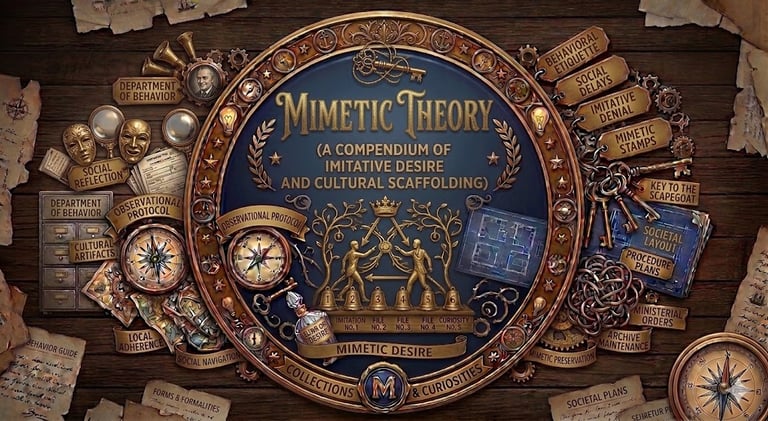
Mimetic Theory is a philosophical and psychological framework explaining human behavior and desire. Its core premise is that human desires are not authentic, autonomous, or self-generated. Instead, humans are fundamentally imitative creatures who learn what to want by watching what other people want. This borrowed desire inevitably forces individuals into fierce competition with one another, generating social conflict that communities historically resolved through the mechanism of a scapegoat.
The Deep Dive
The theory was formulated by French polymath, historian, and literary critic René Girard in his 1961 book Deceit, Desire, and the Novel, and later expanded into anthropology in Violence and the Sacred (1972).
The Triangle of Desire: Girard argued that human needs (like food, shelter, or safety) are biological and direct. Desires, however, are psychological and strictly triangular. A standard view of desire assumes a straight line between a Subject and an Object. Girard corrected this by introducing a third point: the Model (or Mediator). The Subject does not want the Object for its intrinsic value; they want it simply because the Model wants it. The Model’s desire validates the Object's worth.
Mimetic Rivalry: Because the Subject is imitating the Model, they both end up reaching for the exact same Objects—whether that object is a romantic partner, a career milestone, a piece of real estate, or social prestige. As they compete, the Subject and Model stop being teacher and student; they transform into identical rivals. This mimetic rivalry quickly spirals, as each person's escalating desperation fuels the other's obsession, eventually threatening to tear the social fabric of the community apart.
The Scapegoat Mechanism: Girard looked at ancient history and mythology to figure out how early human societies survived this viral, unchecked internal conflict. He discovered that when a community reaches a chaotic boiling point of universal tension, it instinctively resolves it through the scapegoat mechanism. The community unconsciously unites against a single, often vulnerable individual or minority group, projecting all of their collective sins, anxieties, and internal rage onto them.
The False Peace: By expelling or sacrificing the scapegoat, the community experiences an immediate, intoxicating release of tension. Because peace is instantly restored, ancient people assumed the scapegoat possessed magical, divine powers—viewing them as a demon who caused the chaos and a god who brought the cure. This cycle, Girard argued, is the foundational origin of primitive religions, taboos, and human myths, all designed to hide the unvarnished murder that kept the community stable.
Fast Facts
The Silicon Valley Playbook: The theory found a massive second life in 21st-century technology circles through billionaire investor Peter Thiel, who was a student of René Girard at Stanford. Thiel used Mimetic Theory to predict the explosive growth of social media platforms (which run entirely on imitating others' lifestyles and seeking validation) and to warn startups against entering hyper-competitive markets where rivals destroy each other's profit margins just to copy one another.
The Mirror Neuron Connection: Decades after Girard formulated his theory using only classic literature (like Cervantes, Shakespeare, and Dostoevsky), cognitive neuroscientists discovered mirror neurons in the human brain. These specialized cells fire both when an individual performs an action and when they observe someone else doing it, providing a biological foundation for Girard's claims about human imitation.
References
Girard, R. (1961). Deceit, Desire, and the Novel: Self and Other in Literary Structure. Johns Hopkins University Press.
Girard, R. (1977). Violence and the Sacred. Johns Hopkins University Press.
Thiel, P. (2014). Zero to One: Notes on Startups, or How to Build the Future. Crown Business.