Not Worth the Paper It’s Printed on
The Definition
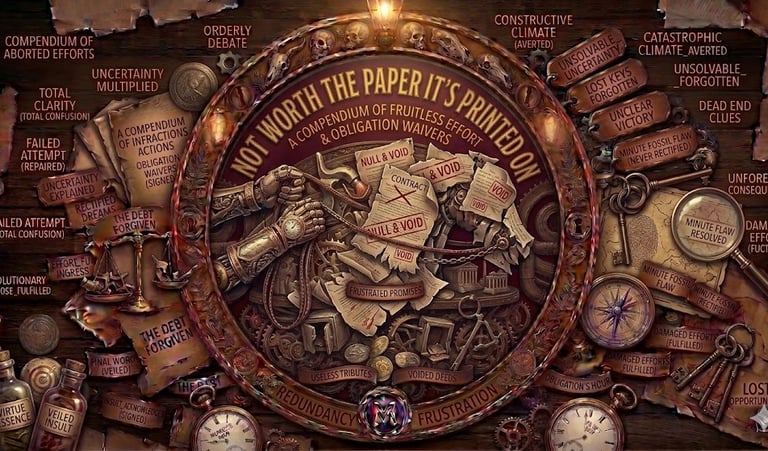
To describe a document, contract, or currency as "not worth the paper it’s printed on" means it is completely worthless, legally unenforceable, or utterly bankrupt in its promises. It signifies a total collapse of value where the tangible material used to carry the information possesses more worth than the intangible commitments written upon it.
The Deep Dive
The phrase is a scathing economic reality check born out of the shift from a tangible barter economy to a world built entirely on trust, paper instruments, and legal abstractions.
The Illusion of Paper: For most of human history, money was money because it was made of a precious metal like silver or gold, and a contract was often sealed with a physical handshake or an unyielding family oath. The introduction of paper money and written legal contracts required a massive leap of collective faith. A piece of paper has no intrinsic value; it is only valuable because a government, a bank, or two signing parties mutually agree to respect the fiction written on its surface.
The Hyperinflationary Engine: The ultimate literal realization of this phrase occurs during macro-economic collapses known as hyperinflation. When a government continuously prints fiat currency to pay off massive debts without the economic output to back it up, the supply of money sky-rockets while its purchasing power plummets to zero.
The Weimar Reality: During the Weimar Republic's hyperinflation crisis in 1923 Germany, the currency depreciated so rapidly that bank notes became literally worth less than the wood pulp used to manufacture them. Citizens discovered that using stacks of cash as wallpaper, burning bundles of banknotes in stoves to heat their homes, or handing millions of marks to children to cut up into kites was vastly more practical and valuable than trying to spend them at a bakery.
The Legal Mirage: In contract law, the phrase took on a parallel, non-monetary meaning. When a rogue business partner or a fraudulent independent contractor signs a complex, sweeping agreement that completely lacks proper legal structure, violates statutory laws, or is signed by a party with zero actual assets, the document is exposed as a total illusion. It cannot be enforced in a court of law. It becomes nothing more than ink drying on wood fibers—a useless piece of trash that gives the recipient a false sense of security.
Fast Facts
The "Continental" Ancestor: Before this phrase solidified into its modern form, early Americans during the Revolutionary War used the expression "not worth a Continental."
The Digital Irony: In the 21st-century digital landscape, the phrase has undergone a modern evolution. With the rise of cryptocurrencies, digital smart contracts, and paperless PDF agreements, people now mock empty tech promises by saying they "aren't worth the bandwidth they're hosted on," demonstrating how our idioms seamlessly shift to mirror the current technology of trust.
References
Fergusson, A. (1975). When Money Dies: The Nightmare of the Weimar Collapse. Kimberly. (The definitive historical text on the material worthlessness of hyperinflated paper).
Ammer, C. (2013). The Dictionary of Clichés. Skyhorse Publishing.
Oxford English Dictionary. (2026). The Lexical Codification of Financial Depreciations and Unenforceable Statutory Instruments.