Telephone Game
The Definition
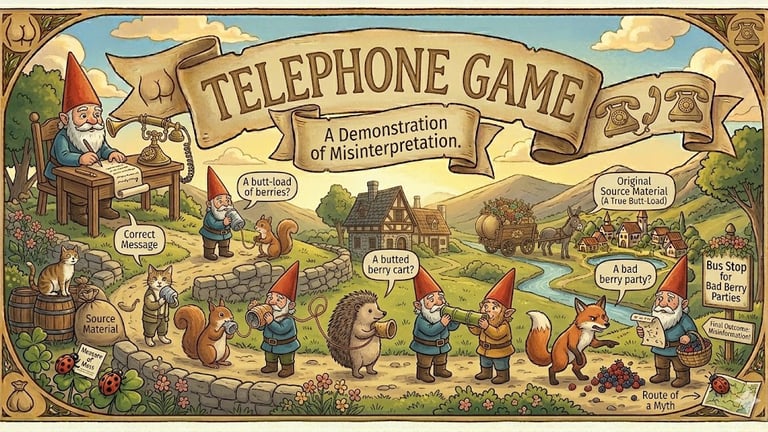
The "Telephone Game" (also known as "Chinese Whispers" in the UK) is a popular children's game used as a metaphor for the cumulative distortion of information as it travels through a chain of people. It demonstrates how a "straightforward" message can mutate into something entirely different—and often nonsensical—by the time it reaches the final recipient.
The Deep Dive
The game serves as a fundamental lesson in the fragility of oral tradition and the psychology of human communication.
The Mechanics of Mutation: In the game, a message is whispered from one person to the next. The "junk" distortion happens because of three factors: physical mishearing (the whisper is unclear), cognitive filtering (the brain fills in gaps with familiar words), and intentional tampering (someone adds a twist for humor). By the end of the line, "The cat is on the mat" might easily become "The bat has a blue hat."
The "Whisper" History: While the origins are difficult to pin down, the game became a staple of Western childhood in the late 19th and early 20th centuries. In the UK, it was historically called "Russian Scandal," implying that gossip in the Russian court was notoriously unreliable. The transition to "Telephone" occurred as the telephone became a ubiquitous, yet often static-filled and unreliable, technology in the mid-20th century.
The "Straight Arrow" Truth vs. Perception: In a professional or historical context, the "Telephone Effect" is a serious concern. It explains how historical myths are born; a single eyewitness account can be polished and altered by subsequent retellings until the original truth is buried under layers of legend.
Modern Social Media: The "Telephone Game" has found a second life as a metaphor for the internet. A single tweet or news snippet can be shared, summarized, and screenshot until the context is completely lost, resulting in a digital version of the "nonsensical final message."
Fast Facts
The "Broken Telephone" Variant: In many parts of the world, including Canada and South America, the game is literally called "Broken Telephone."
Psychological Study: The game is frequently used by psychologists to study serial reproduction, showing that humans tend to simplify complex information and make it conform to their existing cultural expectations as they pass it along.
References
Bartlett, F. C. (1932). Remembering: A Study in Experimental and Social Psychology. Cambridge University Press.
Ammer, C. (2013). The Dictionary of Clichés. Skyhorse Publishing.
Oxford English Dictionary. (2026). The Etymology of Childhood Games and Communication Metaphors.