Trick Up One’s Sleeve
The Definition
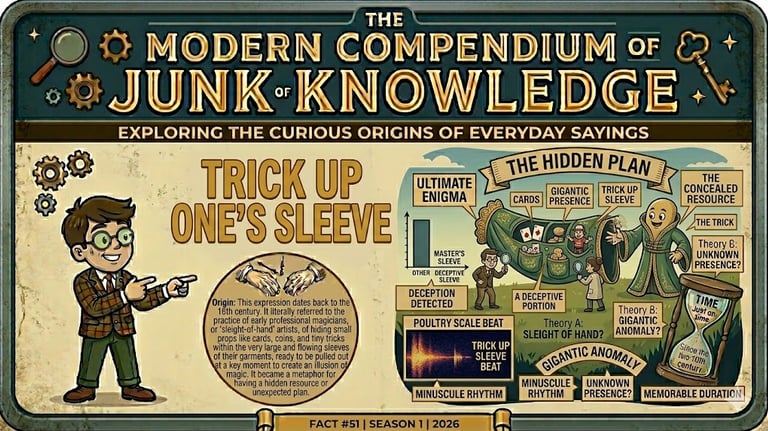
To have a "trick up your sleeve" means to possess a secret plan, an unexpected resource, or a hidden advantage that you keep completely concealed from others until the exact moment it can be deployed for maximum impact. It represents a state of strategic readiness, where an individual deliberately holds back their ultimate piece of leverage to surprise an opponent or rescue a failing situation.
The Deep Dive
Like its structural cousin "nothing up my sleeve," this phrase is born from the literal mechanics of deception, but it traces a dual path through both the theater curtains of stage magic and the green-felt tables of high-stakes gambling.
The Magician's Cache: In 18th and 19th-century stagecraft, magicians relied heavily on loose, tailored clothing to bypass the eyes of the audience. A hidden pocket or an elastic cord sewn inside a coat cuff allowed a performer to secrete a coin, a bouquet of flowers, or a small bird out of sight.
The Card Sharp's Holdout: While magicians used the sleeve to delight, professional gamblers and card sharps used it to survive. In 19th-century America, particularly on the riverboats cruising the Mississippi, card games like poker were highly lucrative and incredibly hazardous. Cheating players invented mechanical devices known as "sleeve holdouts." These were intricate, spring-loaded brass contraptions strapped to the forearm beneath a dress shirt.
The Mechanics of the Cheat: A gambler would use the mechanical holdout to secretly slide an extra Ace or King up into their sleeve during an early round of play. When the betting pool reached its absolute peak, a subtle movement of the elbow or a squeeze of a hidden pressure bulb would activate the spring, silently feeding the winning card directly back into their hand.
The Modern Strategic Inversion: By the early 20th century, the phrase shed its criminal and theatrical associations to become a universally respected corporate and political metaphor. In modern asset management, contract negotiations, or sports strategy, having a trick up your sleeve is no longer viewed as dishonesty—it is celebrated as tactical foresight.
Fast Facts
The "Ace in the Hole" Variant: The phrase is psychologically identical to having an "ace in the hole." This cousin idiom comes from stud poker, where a player's first card is dealt face-down ("in the hole") and kept hidden from opponents, serving as a powerful, invisible anchor for their final hand betting strategy.
The Mechanical Evolution: The historical brass sleeve holdouts are now highly prized collectors' items in the antique world, often fetched for thousands of dollars at auction by historians tracking the industrial engineering of early American gambling fraud.
References
Houdini, H. (1920). Miracle Mongers and Their Methods. E.P. Dutton.
Maskelyne, J. N. (1894). Sharps and Flats: A Complete Revelation of the Secrets of Cheating at Games of Chance and Skill. Longmans, Green, & Co. (The definitive historical text mapping out the engineering of sleeve holdout mechanisms).
Oxford English Dictionary. (2026). The Metaphorical Integration of Stagecraft and Gambling Apparatus in Twentieth-Century Corporate Prose.