Under the Table
The Definition
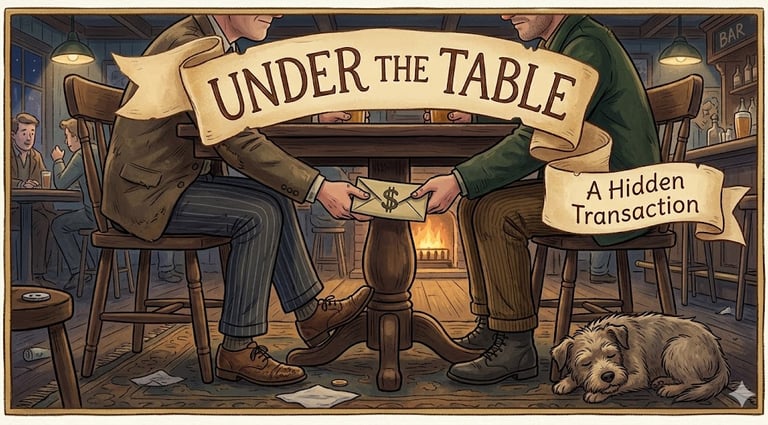
To do something "under the table" means to engage in a secret, covert, or illegal transaction—typically involving cash payments or business agreements—designed to completely evade taxes, government regulations, or official record-keeping. Metaphorically, it can also describe an individual who has consumed so much alcohol that they have collapsed onto the floor, rendering them entirely incapacitated.
The Deep Dive
The phrase is a masterclass in linguistic double-duty, tracing two completely separate historical paths that converged around a single piece of dining room furniture.
1. The Financial Corruption (The Covert Exchange)
The most common modern usage of the phrase refers to illicit financial deals. This origin tracks straight back to the legal and gambling dens of Europe and 19th-century America.
When a transaction is legitimate, money is placed openly on top of a table or counter where all parties, witnesses, and regulators can clearly see the assets change hands. However, when an independent contractor, politician, or businessman wants to execute a bribe, an off-the-books cash payment, or an undocumented labor agreement, the physical geometry of the room dictates the play. By slipping the envelope of cash beneath the plane of the wood—under the table—the transaction is kept entirely out of the sightline of onlookers, auditors, and tax collectors. By the mid-20th century, this physical act became the definitive global shorthand for the underground economy and tax evasion.
2. The Alcoholic Collapse (The Test of Stamina)
Long before it became an economic buzzword, "under the table" was a fierce, literal measurement of a person's heavy drinking capacity.
During the frantic, hyper-indulgent dinner parties of the English Regency and Victorian eras, elite gentlemen would sit for hours consuming massive quantities of heavy fortified wines, like port and sherry. It was considered a matter of intense masculine pride and social stamina to remain upright in one's chair as the evening progressed. An individual who lacked the physical tolerance to handle the alcohol would eventually black out or lose their balance, slipping out of their seat and sliding entirely under the table onto the floor.
The ultimate compliment of this era was to be an operator who could drink all of their rivals "under the table"—meaning you remained clear-headed and seated upright while every other competitor lay unconscious on the floorboards beneath you.
Fast Facts
The "Above Board" Antonym: The direct legal opposite of an under-the-table deal is a transaction executed "above board." This maritime phrase originally referred to gamblers who kept their hands openly above the deck of the ship (the board), proving they weren't secretly shuffling or hiding cards beneath the table.
The Prohibition Blueprint: The phrase experienced a massive surge in American slang during the 1920’s Prohibition era, when speakeasies relied entirely on under-the-table cash flows to secure illegal shipments of spirits from underground suppliers.
References
Ammer, C. (2013). The Dictionary of Clichés. Skyhorse Publishing.
Oxford English Dictionary. (2026). The Lexical Integration of Interwar Underground Currencies and Nineteenth-Century Convivial Slang.